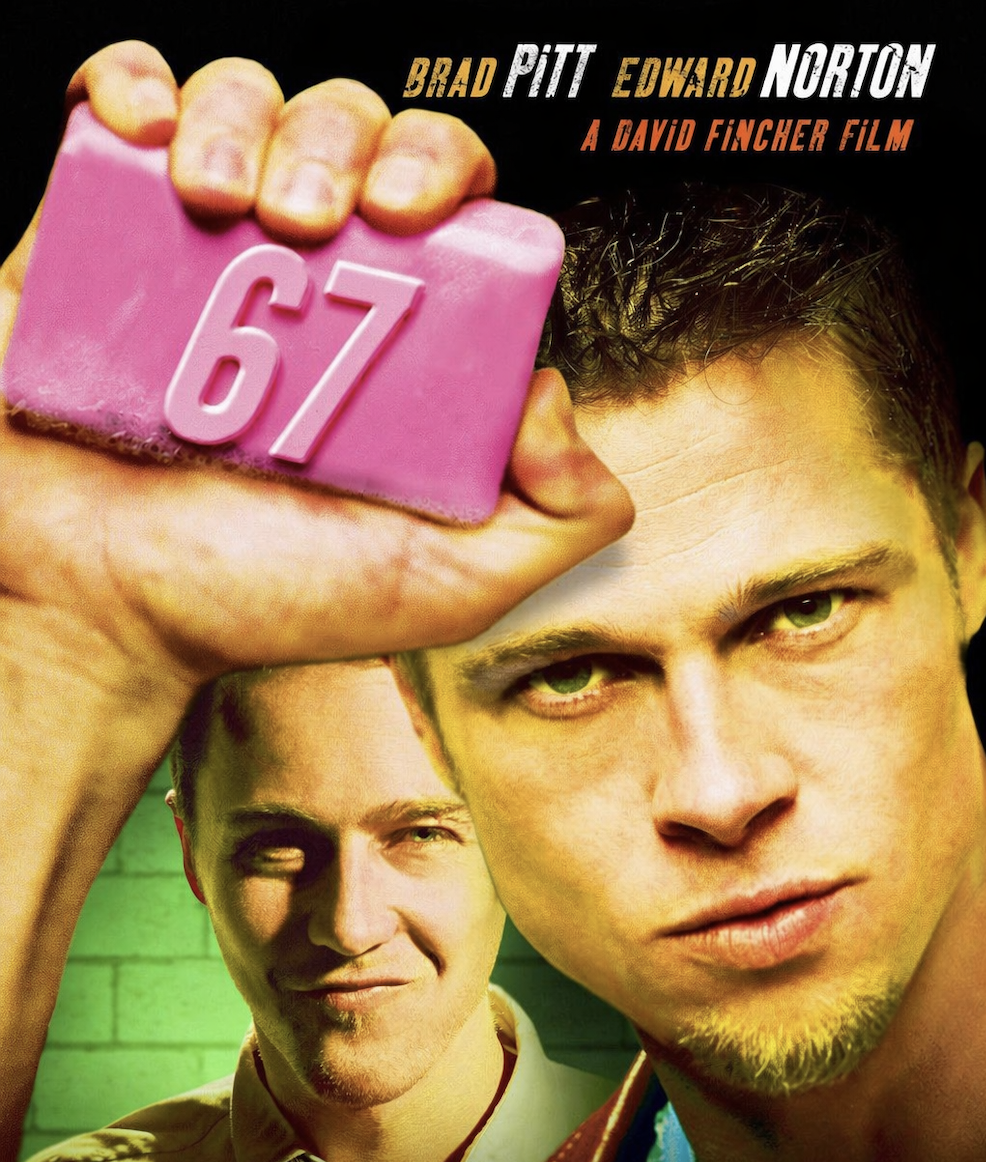
“The first rule of Fight Club is you do not talk about Fight Club.” The irony of this famous saying is that everyone talks about Fight Club. The secret spreads precisely because it’s a secret. Making the paradox of Fincher’s Fight Club the fact that the thing trying to suppress itself becomes the engine of its own propagation. However, as it turns out this is one of the most reliable formulas in the history of viral culture. Which brings us, inevitably, to 6-7.
Richard Dawkins coined the term “meme” in The Selfish Gene (1976) to describe cultural units that replicate, mutate, and compete for the attention of society. A successful meme, in Dawkins’ thesis, isn’t necessarily something that is true or good or even important for our knowledge, instead it’s simply something that sticks. It spreads because it is easy to copy, easy to transmit, and offers some reward (usually being laughter, belonging, or a source of identity) to the host who carries it and will eventually spread it.
6-7 is, by this standard, a near-perfect meme. It began as an ambiguous number in a drill rap song by Philadelphia rapper Skrilla (let it be known that even Skrilla himself has been unable to assign a fixed meaning to this term) and it mutated through contact with basketball highlights, a teenager rating a Starbucks drink, and a screaming child at an AAU game. In fact Dictionary.com named it the 2025 Word of the Year and defined it as “a burst of energy that spreads and connects people long before anyone agrees on what it actually means.” The Merriam-Webster definition is even more interesting: “a nonsensical expression connected to a song and a basketball player.” The meme’s lack of meaning is not some fault of the meme. It’s the entire feature and what makes it a perfect example of Dawkin’s memetics thesis.
This is where Fight Club can teach us something.
Fight Club’s central theme is that systems and ideas can metastasize completely independently and deviate from their original intent. Tyler Durden creates a tight, rule-bound underground organization, purposefully setting rules that exist in an attempt to contain and direct the chaos. But the chaos gets out of hand, scaling beyond Durden’s control, and becomes something its founder no longer recognizes by the end of the movie.
The 6-7 meme followed the same arc with remarkable fidelity. It began as a niche lyric. Then it was basketball player, Lamelo Ball’s, height. Then a teenager’s catchphrase. Then a screaming child’s gesture at a gym. By the end of 2025, the British Prime Minister was apologizing to a headteacher for doing the hand gesture at a school where it had been banned. JD Vance was jokingly proposing a First Amendment carve-out to prohibit the wo numbers. South Park dedicated a season premiere to it.
When taken together, what Fight Club and the 6-7 meme demonstrate about secrecy is that the performance of exclusivity is itself a transmission mechanism. Fight Club relied on the first rule being broken to spread in the manner that it did. The whole point of a secret handshake is that you teach it to someone, to have a little secret, but then to display it, to do that secret handshake in front of others in order to be able to say “haha I understand this and you don’t.” Children’s culture researchers described 6-7 as functioning like a secret language, and have even compared it to Pig Latin: low barrier to entry and easy to learn, high social reward, and a built-in us-versus-them dynamic that makes transmission feel like initiation when in all honesty nobody knows what this means.
This is memetics operating at full efficiency. The meme says: do you know about this? Knowing is belonging. The gesture (hands moving up and down, palms facing upward) is perfect for easy transmission.
The first rule of 6-7 is that you do not need to understand 6-7. And yet here we are, politicians, prime ministers, linguists, and Dictionary.com, all talking about it. All doing the gesture.
The secret spreads because it’s a secret. The nonsense spreads because it’s nonsense. And for one strange year, two numbers and a hand gesture traveled from a drill rap song in Philadelphia to the floor of the United States House of Representatives, not because anyone planned it, but because that’s what ideas do when you let them loose. Memetics in action.