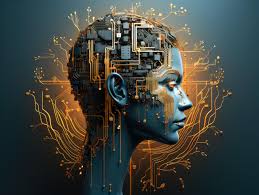
Artificial Intelligence marks the beginning of a new era in human progress, an era that generates both excitement and fear. Fear that machines can now outthink us, replace jobs, and blur the line between what it means to be organic and synthetic. However the truth is that AI isn’t a fully conscious or emotional being. It’s a man-made tool built from mathematical equations, data, algorithms, predictions, ultimately built not to replace us, but to help us solve our hardest problems, reveal patterns, and expand the limits of what we can achieve.
At its foundation, AI is built on the concept of machine learning. Instead of being programmed with every possible rule or response, a machine learning system learns by analyzing large sets of examples. To teach an AI to recognize a dog, for instance, programmers don’t code every possible shape and image a dog might have. They feed it thousands of labeled images. The AI studies these examples, adjusting and learning to create parameters within its model so that it can reliably identify dogs on its own.
This learning process happens through neural networks, which are inspired by the human brain. These networks are made up of layers of virtual “neurons,” each performing tiny calculations. When billions of these are connected, they can handle astonishingly complex tasks such as recognizing voices, translating languages, or writing text that sounds human.
However, AI is far from a single technology. It is an entire scientific field made up of specialized branches, each designed to solve different categories of problems or that have unique improvements or faults:
Narrow AI is the most common use of AI. Narrow AI systems are designed to excel at a singular task, for example recommending videos a consumer would enjoy
watching (TikTok, Youtube, and Facebook recommendations all use this), identifying faces, or detecting credit card fraud. These systems operate strictly within their training and cannot generalize beyond what it is tasked to do. This makes it extremely useful for tasks that require speed and consistency especially for companies where large volumes of data must be analyzed quickly and accurately for specific purposes.
Reinforcement Learning models, these are AI that learn by interacting with its environment. The system receives rewards for good decisions and are penalized for mistakes. This approach is used in robotics, autonomous vehicles, and game-playing AIs, by allowing systems to essentially learn through rewards and punishments how to achieve what the user wants.
Generative AI creates new content based on patterns learned from data. This includes generating text, images, music, or code to name a few. One of the most widely known examples of modern AI is ChatGPT, a Large Language Model (LLM) that is an example of a generative AI. It’s trained on massive amounts of sentences so that it can recognize patterns in language, understand context, and generate responses based on the sentences it’s learned from. Like other neural networks, it learns by adjusting billions of internal parameters during training, which allows it to predict the most likely next word or idea in a conversation. Because of this, ChatGPT can answer questions, explain concepts, write essays, create ideas, and carry on natural-sounding conversations.
AI is a technology that must be approached with caution and balance. Most inventions have been ultimately abused by man for nefarious purposes, so is this the destiny of AI? As we approach the point of Super-Intelligence where AI reaches a level
of intelligence far greater than human limits, we may pass the point of no return, where AI begins its own nefarious agenda. After all, it was created by man.