Something is plaguing the internet, and more specifically, the for-you pages of young men. “Looksmaxxing,” the practice of optimizing one’s physical appearance through any means necessary, has completely taken over social media. These looksmaxxing practices range from mundane stretches to medically terrifying things.
To understand looksmaxxing, you have to understand where it comes from. The movement grew out of forums in the early 2010s in which entire communities were built around the conviction that personal appearance is not circumstantial but purely genetic, and that physical appearance is destiny. These online forums called their worldview “the black pill,” named for the Matrix’s red pill but bleaker and representing the idea that no amount of self-improvement changes your fundamental genetic fate. This “black pill” mentality stated that those who were genetically gifted to be better looking would be able to live happier lives, be treated better, make more money, and ultimately be met with more success in life.
However, looksmaxxing emerged as a rejection of the “black pill” mentality. If appearance controlled so much of one’s life, then these looksmaxxers reasoned that any rational being would do whatever was necessary to optimize appearance. The result was a community built on misogynistic pseudoscience hidden under the guise of “self-improvement”.
The community built itself around Euclid’s facial golden ratio (having different measurements of the face ratio to 1.618, for example, one’s mouth width should be 1.618 times as long as one’s nose base width), attempting to throw math and science as perfectly reasonable excuses for this extreme behavior. One’s canthal tilt (tilt of eye posture), maxilla growth, mandible bone, and chin growth were all seen as individual parts of the body that had to be improved and worked upon, with the methods all being “backed by science.”
Enter Braden Peters, Clavicular. Clavicular is twenty years old and has made a career out of pursuing physical perfection. Clavicular is known for livestreaming and vlogging his “bone smashing,” peptide use, steroid use, and recreational drug use.
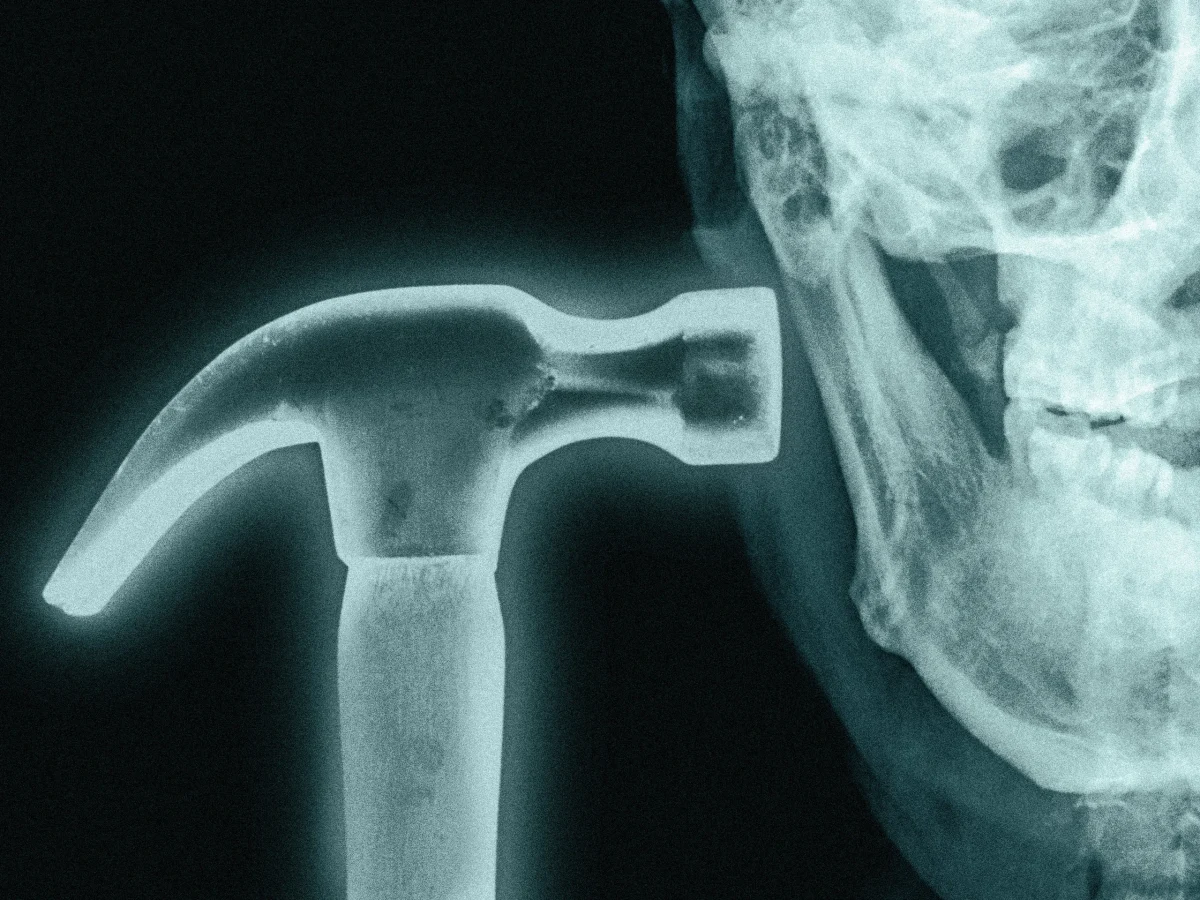
Clavicular has stated publicly that he understands that the looksmaxxing practices have deteriorated his health, but that he isn’t prioritizing longevity. He has advocated using drugs like meth to maintain low body fat because one of its effects is appetite suppression. He advocates for “bone smashing,” repeatedly hitting oneself in the face with a blunt object in the hope of stimulating remodeling (grounded in the misapplication of Wolff’s Law, which states repeated trauma leads to increased bone density). He talks about peptides and compounds like BPC-157 and TB-500, often recommending potentially dangerous drugs to his millions of viewers without considering the risk.
What separates this new wave of looksmaxxing from ordinary vanity is the pharmaceutical dimension, and it is here that the movement has most dramatically expanded its reach. The drugs being discussed and recommended are compounds accessible only to a few.
GLP-1 agonists like semaglutide, which have been sold under the brand names Ozempic and Wegovy (originally developed for diabetes management and now prescribed widely for weight loss), have become a cornerstone of the looksmaxxing toolkit. The appetite suppression they produce allows people to achieve a low body-fat percentage and facial “leanness,” which is said to increase the masculinity of one’s face.
Peptides represent the other frontier of this looksmaxxing drug-use. BPC-157, a synthetic peptide derived from a human gastric protein, is promoted in looksmaxxing circles for its anti-inflammatory effects with the idea being that faster recovery from exercise accelerates physical development. TB-500 is similarly positioned. Neither has been approved for human use by any regulatory body, making its newfound widespread use amongst minors terrifying. Neither has been studied in large-scale human trials. They are obtained through research of chemical suppliers and self-administered, often subcutaneously, by young men who have learned from YouTube videos and Kick livestreams that this is the secret to ascending the physical appearance hierarchy.
Then there is testosterone. Clavicular advocates for using the hormone to achieve more prominent physical features that are desired, jaw definition, muscle mass, brow ridge development, and body hair, all of which are “easily achievable” by simply injecting testosterone into healthy bodies. However, these influencers are not medical professionals. If they were, they would understand that testosterone injections suppress the natural production of testosterone, potentially permanently, and that testicular atrophy is an extremely likely outcome.
But, the most horrifying consequences may not be the faces being produced, but the brains doing the producing. Body Dysmorphic Disorder (BDD) is a psychiatric condition defined by obsessive preoccupation with perceived flaws in one’s appearance, most of which are either minor or entirely invisible to others. It reportedly affects 1-2% of the general population. Its symptoms include compulsive mirror-checking, skin-picking, excessive grooming, repeated requests for reassurance about appearance, and the inability to stop thinking about the perceived defects on one’s body despite wanting to.
BDD has a measurable signature in the brain, and neuroimaging studies have found that BDD patients process their own faces differently at a fundamental level. BDD patients show abnormal activity in visual processing regions, over-processing fine-grained detail instead of a holistic face perception. Essentially, the BDD brain cannot perceive its own face as a whole; it only sees parts that it dislikes and hyperfixates on them.
Now, when considering the looksmaxxing community’s daily practices: hours spent on forums rating faces in extreme close-up detail, photographs taken from multiple angles and submitted for critique, measurements of pupil distance, midface ratio, and canthal tilt, all of these examinations of one’s particular deficiencies and one’s “frame” or the inadequacy of one’s “bone structure,” it becomes clear that this is, in medical terms, a compulsive checking and comparing ritual. This is precisely the behavior that sustains, deepens, and causes BDD. This is no longer self-improvement.
The human prefrontal cortex (the region responsible for perspective forming, long-term consequence evaluation, identity regulation, and the ability to contextualize traumatic and distressing information) is not fully developed until around the age of twenty-five. A minor’s brain is disproportionately governed by the limbic system (the part of the brain responsible for threat response, social comparison, reward-seeking, and emotional reactivity), making minors extraordinarily sensitive to social exclusion and status cues. Evolutionarily, we are built this way because adolescence is the developmental window during which humans establish their position in social hierarchies, form peer bonds, and develop the self-concept they will carry into adulthood (this makes sense given the fact that humans needed to survive and assert dominance during caveman times). It is the window during which identity is most vulnerable.
Thus, introducing a mathematically amplified, relentless comparative environment during that window is not just bad for self-esteem for our youth. It may be reshaping neural pathways during the period when it is most responsive to reshaping. The neural pathways that govern self-perception are being laid down for millions of adolescent boys. For these millions of adolescent boys who live in an environment that tells them their face is a problem to be solved and that failure to solve it will lead to failure in life, we can only guess the detriment that will result from this, but the clinical literature on BDD and adolescent brain development gives us enough to be deeply worried.
It would be a mistake to simply condemn looksmaxxing and the fact that the youth are drawn to it. Male body image has existed in a strange cultural silence for decades, squeezed between a cultural refusal to take male vanity seriously and an equally strong refusal to acknowledge male vulnerability. Boys have always worried about their height, their face, their hair, and their shoulders. However, they have simply hidden so that they didn’t carry the charge of weakness or femininity.
Looksmaxxing gave that anxiety a language and a clinical, pseudoscientific, masculinity-preserving language that allowed boys to discuss appearance obsession without it reading as vulnerable. Looksmaxxing is made so that these boys are not insecure about their face; instead, they are analyzing their appearance and seeing what they need to take control of. In the looksmaxxing community, you are not struggling with how you look; you are optimizing your life. This framework is a defense mechanism dressed up as a discipline, and it is extraordinarily effective at recruiting young men, and more specifically, exactly the boys who need it least, those already predisposed towards clinical dysmorphia.
The extremity of looksmaxxing, the bone smashing, the hormone supplements, the drug use, the peptide stacks, are all a mirror. It reflects an anxiety in young men that has gone unaddressed for generations. However, the problem is not the anxiety; the problem is the solution being offered and advertised. The solution being offered isn’t acceptance or maturity, but a feedback loop disguised as a remedy, leaving kids breaking themselves and calling it progress.